

Associate Professor WU Wenxin Published Research Findings in Strategic Management Journal
Mon, Dec 15, 2025
Are shareholder interests necessarily at odds with those of non-shareholder stakeholders? Finding the right balance between the demands of the various stakeholders involved in social issues is a key concern in strategic management and corporate governance. Addressing this core debate, WU Wenxin, Assistant Professor at the Tongji Institute for Advanced Studies in Management, proposes a novel research perspective. She examines how enterprises adapt their strategies for engaging with social issues in the face of different forms of legitimacy challenges. Her paper, ‘Tailored adaptation: Aligning social issue engagement with types of legitimacy challenges’, which she co-authored with her team and for which she is the first author, has been accepted for publication in the Strategic Management Journal (UTD 24), a leading journal in the field of global strategic management research.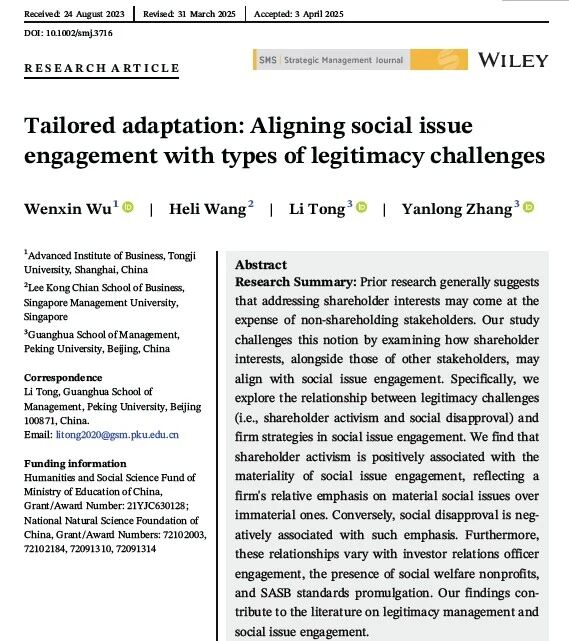
In a rapidly changing social environment, enterprises face ongoing challenges to their legitimacy from both shareholders and non-shareholder stakeholders. These challenges reflect external scrutiny and expectations regarding corporate practices. Traditional perspectives suggest that addressing shareholder interests often comes at the expense of other stakeholders. However, an increasing amount of research indicates that such conflicts are not inevitable. Against this backdrop, the present study proposes that enterprises can meet the varied requirements of their stakeholders by adopting a more nuanced approach to engaging with social issues.
The research identifies two types of challenge to legitimacy: shareholder advocacy and public opinion. Shareholder advocacy typically stems from concerns about a company’s capabilities, prompting it to address social issues highly relevant to its core business that have the potential to enhance corporate value. Public opinion, meanwhile, has moral and diffusive aspects with more unpredictable consequences, making it difficult for companies to respond only to issues closely tied to economic value. Consequently, this study introduces the concept of “substantive engagement with social issues” to explore how companies can calibrate their focus between issues closely aligned with core operations and those of relatively marginal relevance.
The findings reveal that firms achieve more precise stakeholder alignment by adjusting their approach to social issues rather than adopting a uniform response to challenges to their legitimacy. These findings broaden the scope of shareholder activism research and respond to calls within legitimacy management for “tailored strategies”. They provide a new theoretical framework and empirical evidence to help us understand how organizations engage with social issues in diverse stakeholder environments.
ADD:Tongji Building A, Siping Road 1500, SHANGHAI 200092
TEL:0086-21-65983943
FAX:0086-21-65986304
Quick Links:Tongji UniversityMMBSMBSCWRXLRI

We protect your privacy. We use cookies to personalize content, provide features, and analyze traffic to our website anonymously and in a privacy compliant manner. By law, we may store cookies on your device if they are strictly necessary for the operation of this site. For all other cookie types, we need your permission. For more information, please see the privacy policy linked below.

