

Multi‑disciplinary Expertise Pooled to Chart New Urban Visions: Demonstration Meeting Held for Tongji University Laboratory for High‑Quality Urban Development and Planning Decision‑Making
Sat, Aug 15, 2026
The demonstration meeting for Tongji University Laboratory for High‑Quality Urban Development and Planning Decision‑Making took place on August 3, hosted by the School of Economics and Management. Distinguished scholars from leading universities nationwide, alongside Tongji faculty and administrative leaders, gathered to deliberate the laboratory’s strategic positioning, interdisciplinary research pathways, platform building and talent development.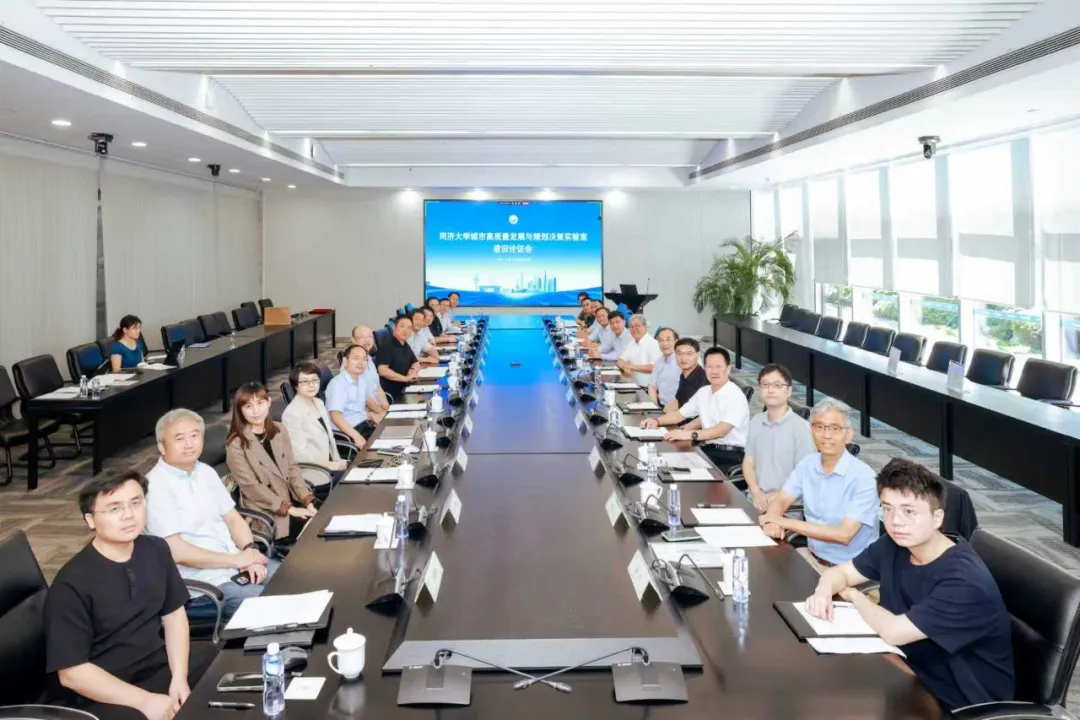
Vice President Xiangning LI chaired the session. Qian SHI, Chairman of the School Council of Tongji SEM, moderated expert deliberations, while En XIE, Dean of SEM and Executive Director of the Laboratory, presented its construction blueprint. Appointment letters were conferred on advisory experts at the event.
Approved in 2025 as a MOE Philosophy and Social Science Laboratory, the platform is led by Tongji SEM and co‑built with multiple faculties including architecture, civil engineering and computer science. It adopts a “1+1+3” framework: anchored in the people‑centered urban philosophy, empowered by big data and AI technologies, and focusing on three core scenarios covering urban operation, growth momentum, resilience and sustainability. It conducts research on urban renewal, industrial innovation, risk warning, infrastructure safety and digital governance, to advance China’s independent knowledge system for urban governance.
External experts affirmed Tongji’s solid foundation in urban studies. They suggested the laboratory should sharpen its distinctive positioning, prioritize real‑world urban challenges, boost cross‑faculty data sharing and develop urban‑agent‑driven research. Academician Zhiqiang WU emphasized that perceiving, self‑learning urban agents should become the laboratory’s landmark achievement to provide scientific support for major urban decision‑making.
Tongji internal participants put forward proposals on research priorities, site allocation and operational guarantees. In his closing speech, Xiangning LI stressed that the laboratory will integrate theories, technologies and practical demonstrations, and establish a tangible output system consisting of urban agents, datasets, decision‑making reports and pilot applications.
Building broad consensus for future progress, the meeting paves the way for the laboratory to evolve into a high‑level platform serving national strategies and leading innovative urban‑governance research.
ADD:Tongji Building A, Siping Road 1500, SHANGHAI 200092
TEL:0086-21-65983943
FAX:0086-21-65986304
Quick Links:Tongji UniversityMMBSMBSCWRXLRI
We protect your privacy. We use cookies to personalize content, provide features, and analyze traffic to our website anonymously and in a privacy compliant manner. By law, we may store cookies on your device if they are strictly necessary for the operation of this site. For all other cookie types, we need your permission. For more information, please see the privacy policy linked below.

