

Family‑Dual‑Track Mechanism Boosts Entrepreneurship: Professor LI Wenchao Published in Journal of Development Economics
Sun, Sep 20, 2026
Professor LI Wenchao from the Department of Economics and Finance, Tongji University School of Economics and Management, together with her co‑authors, has published new research in Journal of Development Economics. Entitled D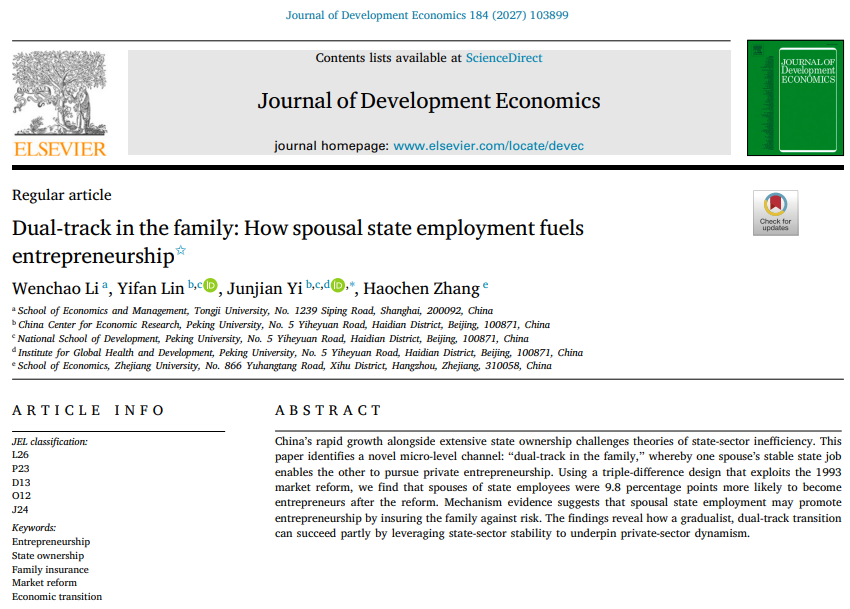 ual‑track in the family: How spousal state employment fuels entrepreneurship, the paper explores a novel micro‑level channel behind China’s market transition: the “family‑dual‑track” mechanism. Against the backdrop of China’s sustained economic growth alongside a large state‑owned sector, she investigates positive spill‑over effects between state‑sector employment and private‑sector entrepreneurship, offering fresh empirical evidence for understanding China’s gradual reform.
Drawing on China Health and Nutrition Survey data and employing a triple‑difference empirical strategy, the research reveals that stable state‑sector jobs with comprehensive welfare serve as household risk‑sharing buffers. When one spouse holds state‑sector employment providing steady income, healthcare and pension benefits, the family obtains an informal safety net that compensates for underdeveloped formal insurance markets during economic transition. This significantly raises the willingness of the other spouse to engage in high‑risk entrepreneurial activities. After the 1993 market‑oriented reform, individuals with state‑employed spouses saw their probability of starting businesses rise by 9.8 percentage points. Such risk‑guarantee effects also encourage entrepreneurs to enter risk‑intensive industries and increase R&D investment.
The study yields important theoretical and practical implications. It revisits long‑standing debates on state‑sector efficiency by identifying a positive externality operating at the household level. For policymakers, the findings highlight that state‑sector stability can indirectly energize private innovation through intra‑family risk pooling. Rather than merely focusing on firm‑level performance, policy design should take household‑level risk‑sharing into account when supporting entrepreneurship and market development.
ADD:Tongji Building A, Siping Road 1500, SHANGHAI 200092
TEL:0086-21-65983943
FAX:0086-21-65986304
Quick Links:Tongji UniversityMMBSMBSCWRXLRI

We protect your privacy. We use cookies to personalize content, provide features, and analyze traffic to our website anonymously and in a privacy compliant manner. By law, we may store cookies on your device if they are strictly necessary for the operation of this site. For all other cookie types, we need your permission. For more information, please see the privacy policy linked below.

