

Does Trade Friction Reshape Hollywood’s China Market? Tongji SEM Research Published in The Review of Economics and Statistics
Thu, Nov 05, 2026
Can tariffs and other economic pressure tools erode a country’s long-built soft power? A new study by Associate Professor Yichuan HU from the Department of Economics and Finance at Tongji SEM addresses this question and has recently been accepted by The Review of Economics and Statistics, a leading international journal in economics.
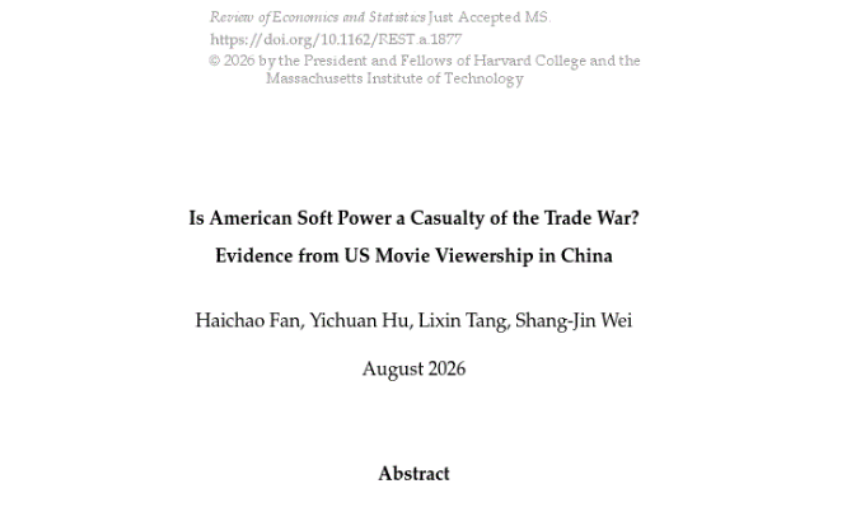
Co-authored with Haichao FAN (Fudan University), Lixin TANG (Jinan University) and Shang-Jin WEI (Columbia University), the paper is titled Is American Soft Power a Casualty of the Trade War? Evidence from US Movie Viewership in China. Extending the analysis of trade consequences beyond traditional economic outcomes into cultural identity and national image, the study examines whether US unilateral tariffs imposed on China during 2018–2019 weakened American soft power, revealing hidden costs of trade protectionism.
US movies are treated not merely as entertainment products, but as key cultural carriers of American values, lifestyles and national image. The researchers therefore use Chinese audiences’ viewing behavior as a proxy for US soft power. Exploiting the fact that Chinese cities with different industrial structures were exposed to tariff shocks to varying degrees, they compare changes in local US movie box office revenues before and after the trade friction to identify the causal effect of American tariff policy.
The study finds that regions with higher tariff exposure experienced sharper declines in US movie box office. In contrast, revenues of Chinese domestic films and movies from other foreign countries did not show a similar pattern, and overall cinema demand did not contract significantly. This indicates that the decline was driven primarily by shifting consumer attitudes toward American cultural products rather than reduced household income or weaker aggregate demand. The effect is more pronounced for action films and dramas carrying distinctive American cultural features, while movies featuring Chinese lead actors or Sino-foreign co-production are notably less affected.
The findings demonstrate that economic policy consequences can extend into cultural consumption. When deploying trade instruments in international relations, governments should also account for their potential impact on cultural exchange and overseas soft power. The authors note that rigorous research on real-world trade issues requires combining credible causal identification with institutional context and mechanism analysis, especially when abstract concepts such as soft power are measured through concrete data and scenarios.
Associate Professor Yichuan HU holds a PhD in economics from The Chinese University of Hong Kong. His research focuses on corporate finance and international investment, with publications in journals including Journal of International Economics, Journal of International Business Studies, Journal of Corporate Finance and European Economic Review.
ADD:Tongji Building A, Siping Road 1500, SHANGHAI 200092
TEL:0086-21-65983943
FAX:0086-21-65986304
Quick Links:Tongji UniversityMMBSMBSCWRXLRI

We protect your privacy. We use cookies to personalize content, provide features, and analyze traffic to our website anonymously and in a privacy compliant manner. By law, we may store cookies on your device if they are strictly necessary for the operation of this site. For all other cookie types, we need your permission. For more information, please see the privacy policy linked below.

